Posts
두 갈래로 씁니다. 하나는 AI와 경제학이 만나는 지점을 한 편으로 끝까지 따라가는 장문 분석이고, 다른 하나는 계량경제학·인과추론·머신러닝을 코드로 직접 확인하는 기술 포스트 시리즈입니다.
Featured
5 long-form pieces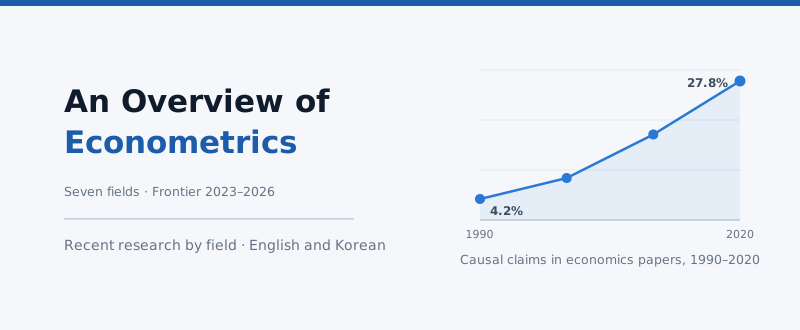
An Overview of Econometrics and Recent Research by Field
Econometrics splits into seven branches that share one framework: identification, estimation, and inference. The 2023–2026 frontier runs in three directions: re-asking what an estimator actually estimates, inference that stays valid when the model is wrong, and inference with data made by AI. Drawing on the recent literature, it covers new work in six fields (microeconometrics, machine learning, time series, financial econometrics, structural estimation, and theory) and how tech companies design experiments. In English, with a Korean version.
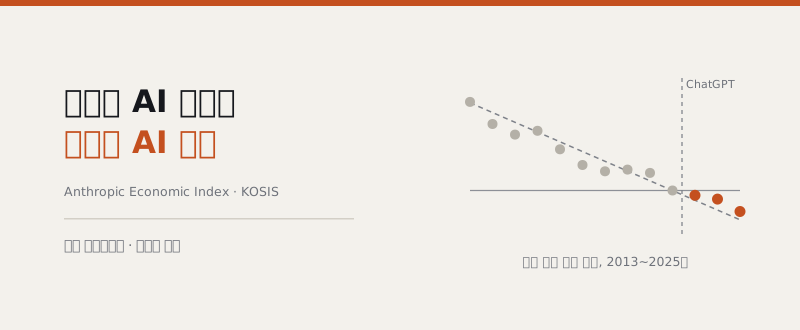
AI Adoption and Occupational Exposure in Korea
한국은 소득 수준이 비슷한 선진국보다 Claude를 약 1.6배 집약적으로 쓰고, 15~29세 취업자는 2022년 10월 이후 10.8% 줄었습니다. Anthropic의 직업별 관측 노출도를 한국 직업분류에 연결해 보면 노출 직업의 청년 고용은 2013년부터 이미 줄고 있었고, ChatGPT 이후 뚜렷한 단절은 보이지 않습니다. 다만 공개 통계표로는 약 12%까지의 하락을 배제하지 못합니다. 영문 워킹페이퍼와 한국어 번역을 함께 실었습니다.

아마존이 마켓플레이스를 경제학으로 설계하는 법
추천을 받은 셀러의 매출이 올랐다면, 그건 추천 덕분일까 아니면 원래 잘하던 셀러가 추천을 받은 것뿐일까. 아마존은 이 질문에 답하려고 경제학 박사 수백 명을 고용했습니다. Double ML부터 Causal Forest, BSTS, 스필오버 설계까지 여섯 가지 방법론을 코드와 함께 짚고, 마켓플레이스 운영에 적용할 지점을 정리했습니다.

AI는 고장 나지 않는다, 시스템이 고장 난다 — 실무자를 위한 5구역 진단 지도
개발자들은 19% 느려졌는데 20% 빨라졌다고 믿었고, 기업 AI 파일럿의 실패율은 80%에 이릅니다. 그런데 범인은 대개 모델이 아닙니다. 입력·맥락·검색·추론·실행 다섯 구역으로 고장 지점을 나누고, 증상에서 출발해 원인을 짚어가는 진단 지도 — 그리고 그 뒤에 있는 2025~2026년의 연구들.

밀도의 덫 — 우버×딜리버리히어로를 경제학과 AI로 읽다
우버는 99개 시장을 샀습니다. 그런데 배달의 네트워크 효과는 반경 3km 안에서 끝나고, 국경을 넘는 인수는 그 밀도를 단 1건도 늘려주지 못합니다. 그렇다면 148억 달러는 무엇을 산 값인가. 3면 시장과 멀티호밍, 알고리즘 규모의 경제, 공정위 심사 쟁점, 그리고 반증 가능한 예측 다섯 개까지 따라갑니다.
Tech Posts
24 posts2025년 한 해 동안 격주로 쓴 시리즈입니다. 기초 도구에서 시작해 실험 설계와 인과 추론을 거쳐 머신러닝으로 이어지도록 순서대로 배치했고, 각 편은 개념 설명·코드 해설·실전 적용을 함께 담고 있습니다. 위에서부터 읽으면 한 과목이 됩니다.
Basics & Econometrics
The groundwork: the Python toolchain, sampling theory, model validation, and the ways an econometric model quietly goes wrong.
Experimental Design
Randomisation, power, and what an A/B test can and cannot tell you once the sample stops being ideal.
Causal Inference
Estimating effects when you could not randomise — matching, instruments, discontinuities, and differences-in-differences.
Machine Learning
Dimension reduction and regularisation, viewed through the question an economist actually asks: which coefficients can I trust?
Series Overview
The whole series in one place, with the notebooks behind each post.